

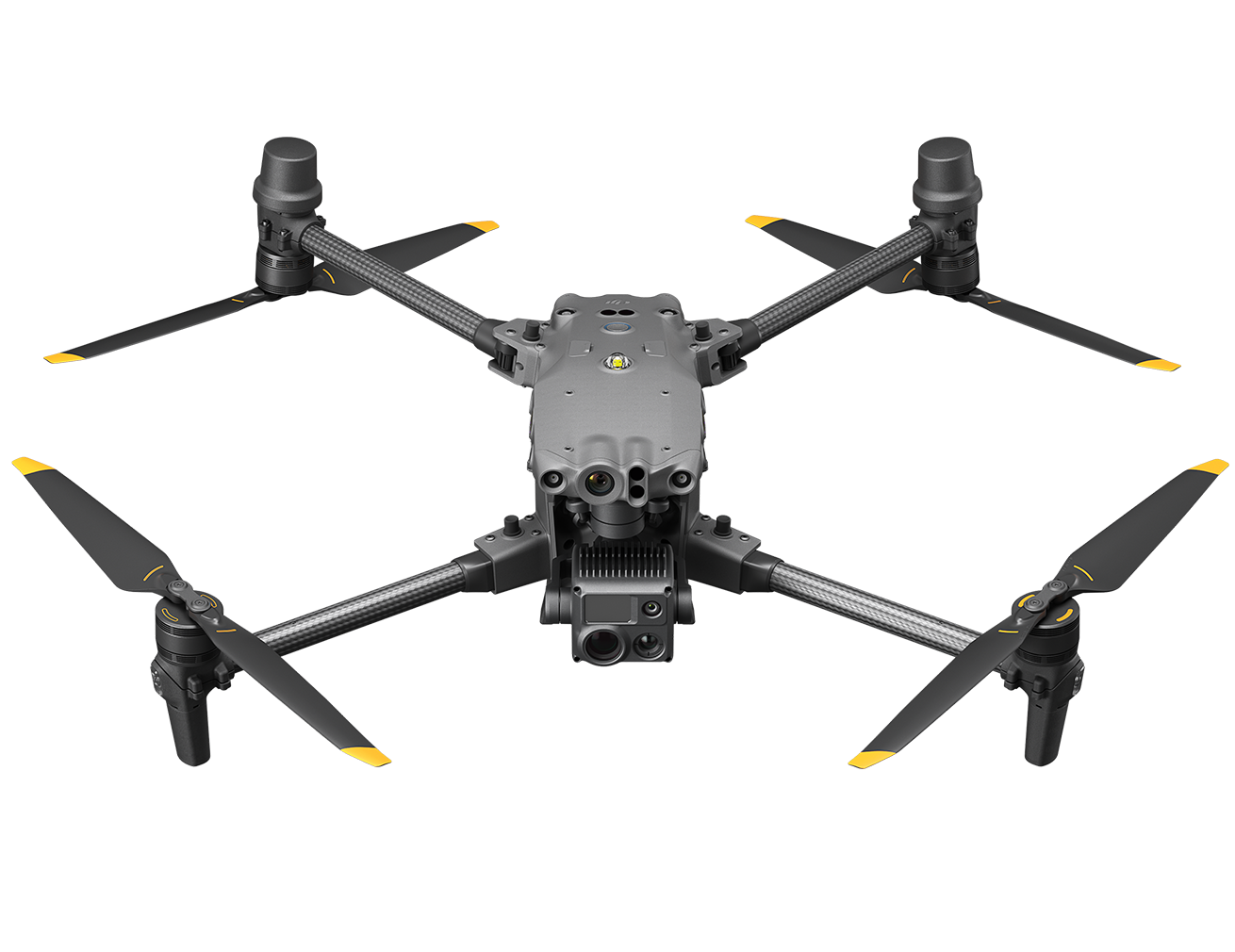
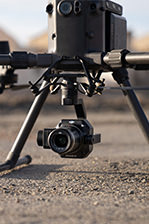
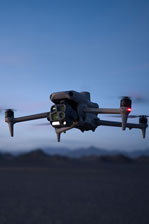
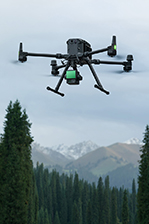
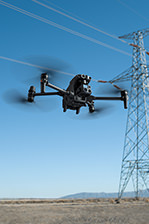



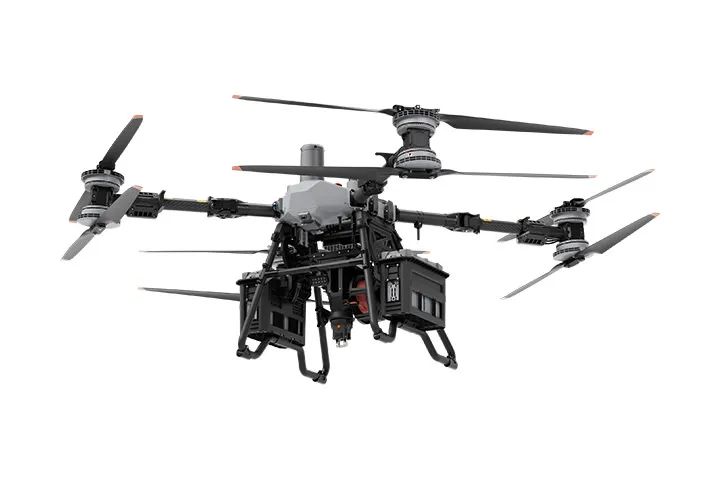
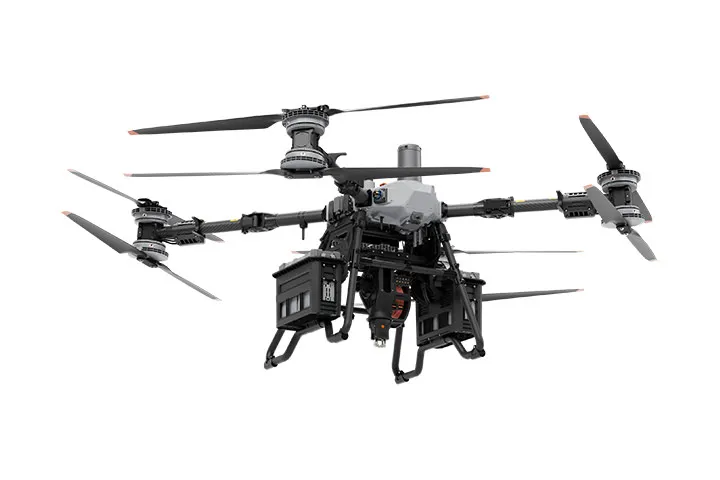
DJI FlyCart 100 (4 Battery Combo)
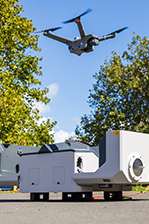
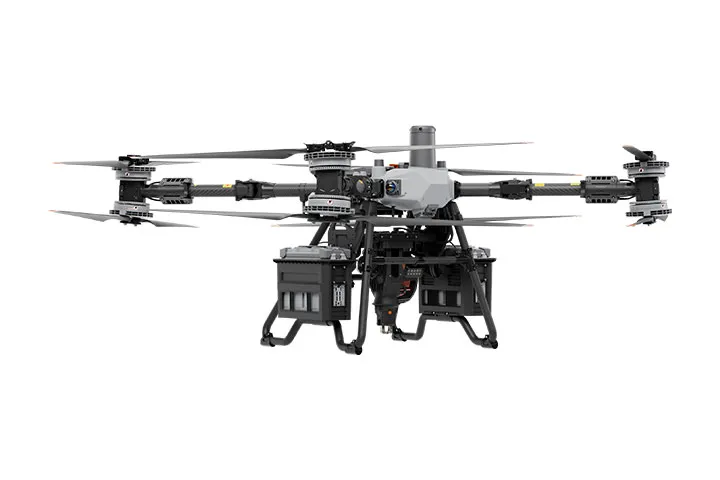
Redefine aerial delivery with the DJI FlyCart 100. Featuring a massive 85kg payload capacity, 12km range, and advanced safety systems including LiDAR and an integrated parachute. Built for heavy-lift logistics in all environments.
Achieve More Deliveries
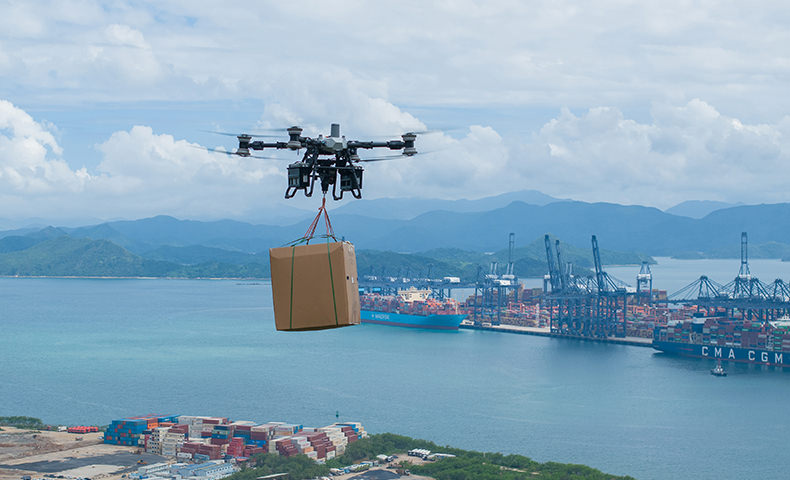
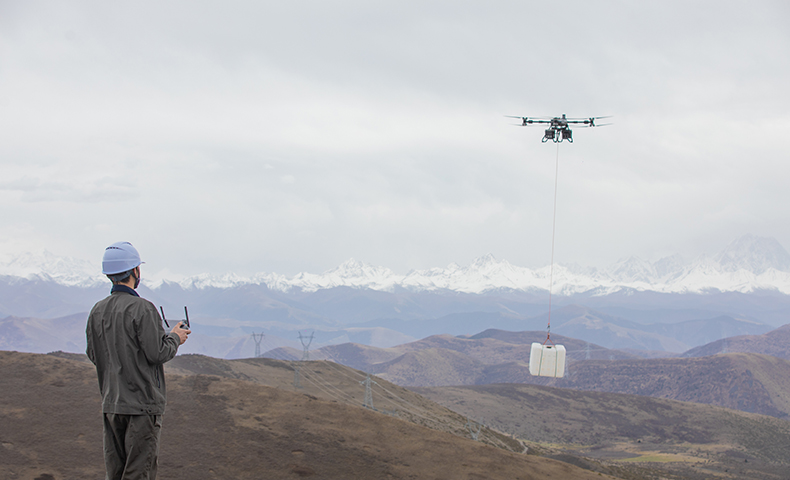
Introducing the brand new DJI FlyCart 100, 85 kg[1] payload capacity with dual battery, 2 payload systems, integrated seamlessly with a powerful developer ecosystem, redefine professional delivery and break through the operational boundaries. The intelligent and advanced Safety System enables unstoppable delivery from mountains to oceans, unlocking infinite possibilities.
Greater Load, Superior Performance
Carry heavier and reach farther, expertly balances excellent performance with power efficiency. Experience efficient delivery.
85 kg Max Payload: with Dual Battery[1]
12 km Max Flight Distance: with 149.9 kg Takeoff Weight[2]
82 kg Max Single-Axis Thrust: 32% Enhanced Power Efficiency[3]
Supports Single Battery and Dual Battery Mode: 100 kg Max Payload with Single Battery[1] | 85 kg Max Payload with Dual Batteries[1]
Coaxial Dual-rotor
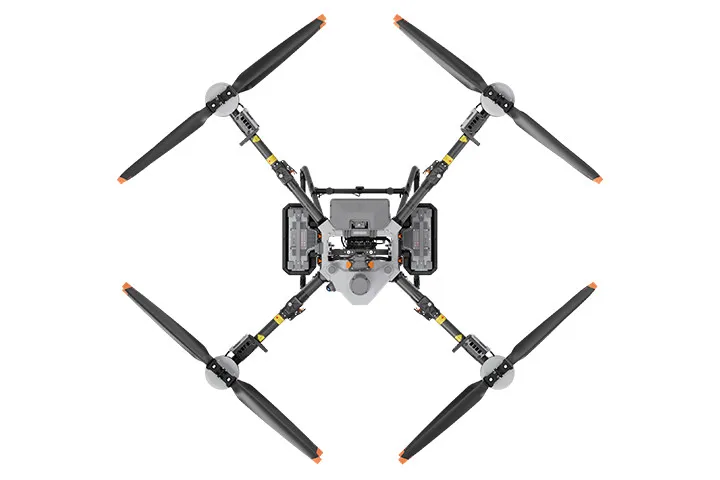
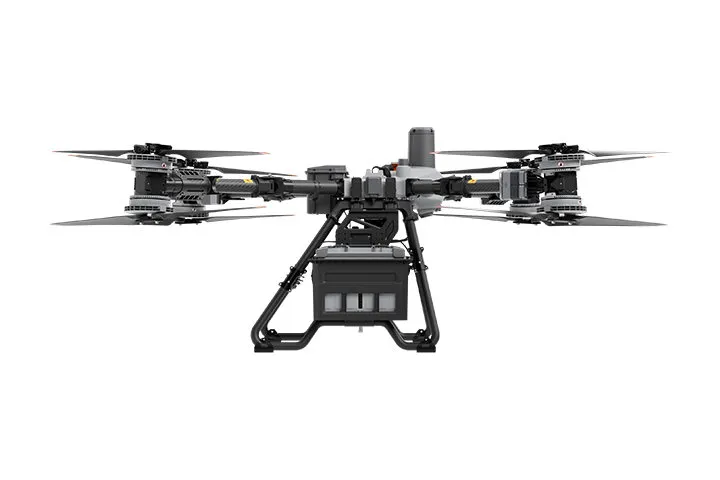
Compact size, high load capacity. Powerful propulsion system offers enhanced safety redundancy, featuring Propeller Stop Protection for added security and reliability.
62-inch Carbon Fiber Propellers
Carbon fiber propellers offer greater rigidity and lighter weight, can resist deformation even at high temperatures. With Optimized airfoil and enlarged propeller diameter, energy efficiency is improved. The upper motors are equipped with Propeller Clamps, which reduce propeller vibration for more stable flight.
Motor and ESC
Larger motors, more torque. ESC with 420A current ensure stable and reliable operation, providing faster response times.
Intelligent Deliver Control, Ultra-fast Response
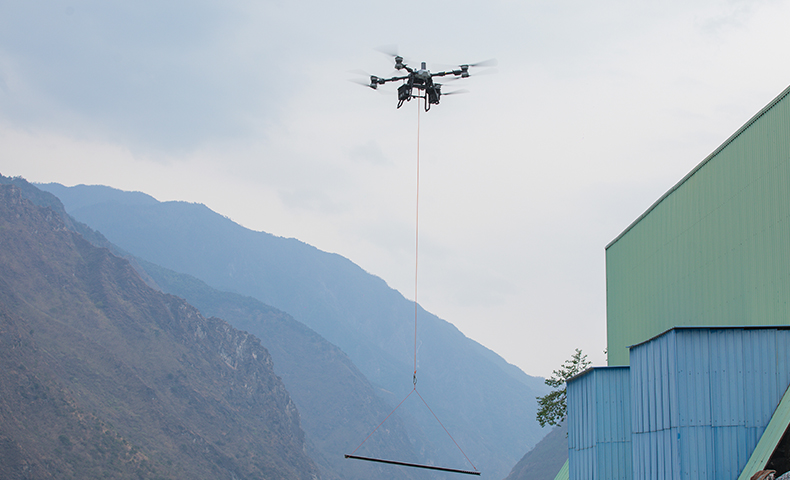
FC100 supports 2 payload systems, the brand new Flagship Winch System, equipped with an Electric Hook for efficient loading and unloading. Also compatible with DJI Dual-Battery Lifting System, flexibly adapting to various delivery scenes.
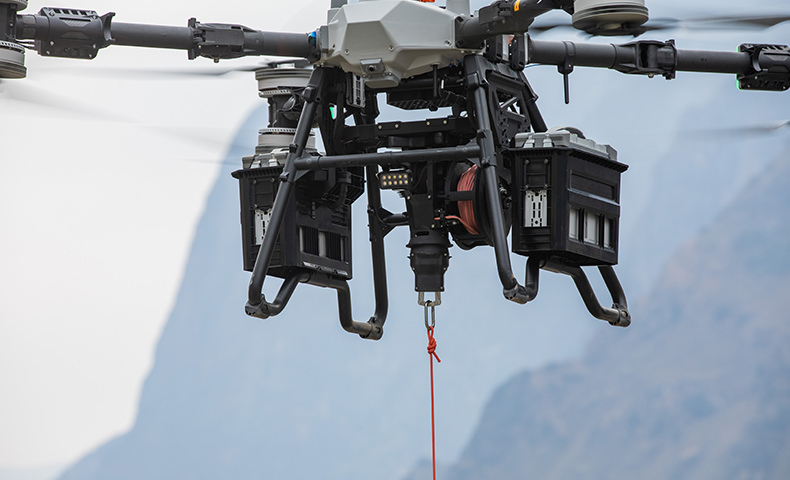
DJI FlyCart 100 Flagship Winch System
Electric Hook: Electric Opening and Closing[4]
Wireless Charging: Convenient and Hassle-Free[5]
Real-Time Weighing: Avoid Overloading, Convenient for Settlement
Audible and Visual Alerts: Safe Loading and Unloading
Winch System Features:
High-Speed Release and Retrieve: Winch system offers both automatic and manual release and retrieval options, equipped with a rope length of 30m, it can maintain a retractable speed of 1.2 m/s with heavy loads, ensuring efficient and reliable operation.
Safe Unloading: Cargo releases automatically upon touchdown, and the hook can be remotely controlled to open, ensuring safe and precise delivery.
Auto Balance Control: The combination of a triaxial force sensor and intelligent algorithms enables minimize cargo swing and improve stability.
Cable Discard Escape: For extreme situations when hanging cargo gets trapped or tangled, discard the cable entirely with one click and let the drone free.
DJI Dual-Battery Lifting System
Auto Balance Control: Minimize swing with a single click for smooth delivery.
Rope Cut Escape: Heat and melt the rope with one click to free the drone for safe disentanglement.
Real-Time Weighing: Avoid overloading, convenient for settlement.
Deliver with Ease in Complex Environments
DJI FC100 Intelligent Safety System, equipped with new LiDAR, Millimeter-Wave Radar[6], and Penta-Vision System. These features enable comprehensive environment awareness, allowing for precise obstacle detection[7].
LiDAR: Capable of capturing dense spatial point cloud up to 300,000 points per second, providing a detailed view of complex terrains. It can capture obstacle more clearly than FPV during nighttime operations.
Millimeter-Wave Radar: The front radar performs 5,000 vertical scans per second combined with 360° horizontal mechanical rotation scanning, along with a down radar and a rear radar offering a more comprehensive detection range.
Penta-Vision System: The quad-vision system, pairing with an FPV low-light full-color camera, facilitates unrestricted viewing of flight scenes in front, rear, left, right, and underneath to detect obstacles more intelligently.
Night Navigation Light: Newly added front-facing high & low beams and downward supplemental light, ensuring safer nighttime operations.
DJI AirSense[8]: A built-in ADS-B in detects and warns nearby crewed aircraft.
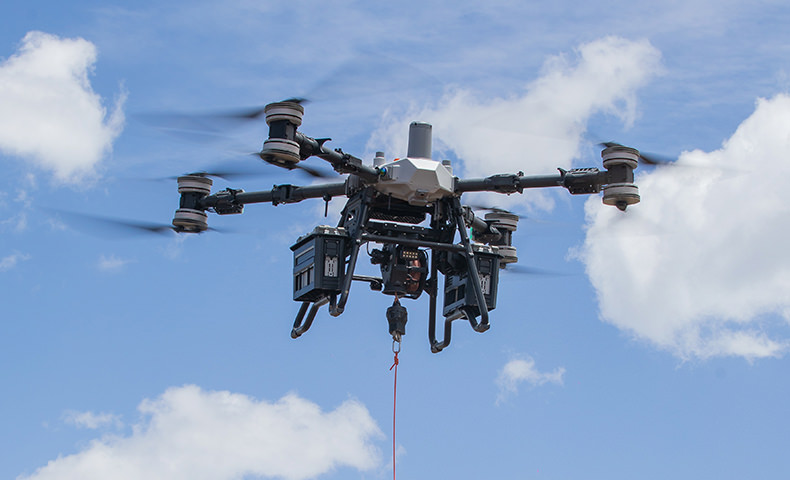
Comprehensive Protection for Entire Operation
From takeoff to landing, from routine to emergency situations, DJI FC100 provides comprehensive protection for personnel, drones, and cargo cross all scenes.
AR Safety Assistance[9]: During takeoff and landing, DJI FC100 supports AR pedestrian and vehicle detection. Besides, reture-to-home mode activates landing point projection for enhanced touchdown guidance and safety.
Auto Slope Ascent: Real-time terrain perception ensures that an aircraft maintains a minimum altitude above the ground, as specified by preset safety thresholds. Safe flight in complex terrain.
Obstacle Avoidance for Cargo[7]: Innovative obstacle avoidance algorithms ensure the aircraft and its cargo can avoid obstacles, effectively minimizing the risk of entanglement in complex scenarios.
No-roll Flight[23]: Newly supports No-roll Flight, improving crosswind stability and enhancing fault-tolerant control performance in the event of power loss.
Integrated Parachute
The integrated parachute features multi-redundancy and can deploy at low altitude under maximum takeoff weight conditions, which can effectively slow down the aircraft's touchdown speed and minimize risk to people and property.
High-performance Canopy: corrosion-resistant, low air permeability
Independent Control: Independent power supply, independent storage
Multiple Protection: Intelligent power-on self check, propellers stop rotation before parachate opening
Safety and Reliability: Touchdown speed can be reduced to 7 m/s[10]
Deliver Beyond Limits
DJI FC100 underwent multiple reliability tests, such as high and low temperature operation tests, wind tunnel tests, winch release and retrieve tests, electric hook opening and closing tests, and parachute opening tests. Forged through rigorous trials, the drone can fly in extreme conditions.
6000 m: Max Flight Altitude[11]
12 m/s: Max Wind Speed Resistance[12]
IP55: Ingress Protection Rating[13]
-20° to 40° C: Operating Temperature[14]
Ultra-Fast Charging, Efficient Operation
DJI FC100 supports ultra-fast charging, enables hot-swapping for seamless, uninterrupted flight operations.*
(*Accessories may vary by region, please consult your local dealer for more details.)
DB2160 Intelligent Flight Battery
Dual Battery Redundancy: In dual-battery mode, the two batteries work as backups for each other. If one battery fails during flight, another battery will keep the drone flying and avoid accidental power-off.
Battery Hot-swapping: In dual-battery mode, enabling battery hot-swapping for seamless, uninterrupted flight operations.
Battery Heating[15]: In low-temperature, the battery is heated to its optimal operating temperature by using DJI Battery Incubator, allowing the battery to continuously retain warmth for stable performance even in extremely cold regions.
Multiple Charging Equipments, Matching Various Charging Scenes
C12000 Intelligent Power Supply: Tri-phase power input, 12000 W fast charging[17], Adaptive power protection, 1.8 m charging cable.
C10000 Intelligent Power Supply: Single-phase power input, 9000 W fast charging[17], Adaptive power protection, 1.5 m charging cable.
D14000iE Multifunctional Inverter Generator: 11500 W fast charging[16], 1500 W AC output, 1.8 m charging cable.
Remote Controller and Video Transmission
Effortless Handling, Stable Transmission
DJI RC Plus 2 features a 7-inch high-brightness screen and supports Dual Controller Mode[18], allowing two pilots to conveniently transfer control permissions to meet diverse operation requirements.
IP54: Ingress Protection Rating, Water and Dust resistant
-20° to 50° C: Operating temperature, withstands extreme weather conditions, enabling day and night operation
7-inch: High-brightness Large Screen, Peaking brightness of 1,400 nits, clear even in strong light
O4 Video Transmission
20km O4 Video Transmission[19]: The upgraded O4 video transmission ensures constant signal availability and smoother videos.
4G Enhanced Video Transmission[20]: Optional DJI Cellular Dongle Kit, when the O4 Video Transmission signal encounters interference but the mobile network remains strong, it can be automatically switched to mobile network transmission. Effortlessly manage complex scenarios, such as navigating mountainous obstructions.
O4 Relay: When the signal is interfered and there is no mobile network coverage, the relay function of the D-RTK3 Multifunctional Station[21] ensures smooth operation.
Dual Controller Mode[18]: Two pilots can control one aircraft. When the DJI FC100 is connected to two remote controllers simultaneously, both controllers have full control and video transmission capabilities. The feature allows primary and secondary pilots to switch and adjust the control to the drone in a long flight.
DJI Delivery App
Simple, Yet Extraordinary. One Touch, Instant Access.
The all-new DJI Delivery App is designed for delivery, featuring a streamlined interface and enhanced functionality. It clearly displays the drone's real-time flight status and cargo transport details. New features like A-B Route Operation Mode and AR Display significantly boost operational efficiency.
Automatic Flight: Tap-to-Fly: Freedom to choose destinations, simplicity to arrive.
A-B Route Operation Mode: After configuring the loading point A and unloading point B with a remote controller equipped with an RTK module, these settings can be synchronized to the pilot's remote controller. The pilot can then use AR projection to quickly position the point A and point B.
Multi-View Assisted Flight: The quad-vision system, combined with an FPV low-light full-color camera, enables simultaneous monitoring of the forward flight environment and downward cargo status, offering a more comprehensive view of the flight. With the addition of AR flight route and AR obstacle detection, flights are made significantly safer.
Winch System Adapts Waypoint Action: Preset the waypoint actions, enabling automatic completion of deliver tasks even in disconnected scenes.
DJI DeliveryHub
Strategic Planning, Multi-Device Collaboration
DJI DeliveryHub, a one-stop air delivery management platform, it's compatible with the entire DJI FC series. It supports efficient operation planning, comprehensive operation status monitoring, centralized team resource management, and data collection and analysis. Combining professionalism and ease of use, it facilitates efficient multi-platform collaboration and provides seamless one-stop transport management.
Operation Planning: Efficient Operations
Operation Status: Comprehensive Overview
Team Resources: Centralized Management
Intelligent Warning: Safety Protection
A Brand New Ecosystem, Ready to Shine
DJI FC100 supports PSDK, a high-power interface, and new DeliveryHub Sync 2.0, opening up more possibilities beyond delivery.
Supports PSDK: Supports external payloads[22], allowing for easy multi-purpose use. Unlock potential applications and redefine payload capabilities.
Supports High-power Interface: Supports up to 3000 W high-power charge interface, meeting the power requirements of most external payloads. More possibilities, stemming from this.
New DeliveryHub Sync 2.0: Unlocks more DeliveryHub functions, supporting third-party platforms integration.
Terrain Follow Flight: Precise terrain variation detection enables automatic altitude hold via relative height setting. When equipped with detection payloads, measurement accuracy is significantly enhanced.
Data Security
DJI takes the security of your data seriously. We use best-in-class measures to protect the integrity of your photos, videos, flight logs, and other user data, allowing you to confidently use the full power of a cloud-based fleet management system. DJI FC100 and DJI DeliveryHub is built to maintain integrity across multiple levels of the drone and data management process – from device connection and maintenance, to data upload and transmission, to cloud service storage and operational security. DJI DeliveryHub uploads, stores and manages data on cloud servers operated by Amazon Web Services, which are compliant to ISO/IEC 27001 security certifications.
Notes:
[1] The 170kg maximum takeoff weight is the performance specification of the drone. Please follow local laws and regulations in actual use. In the following countries and regions the maximum takeoff weight is restricted to 150kg: Brazil, Japan, Australia, Turkey, Saudi Arabia.
[2] This data is obtained from DJI FC100 equipped with fully charged new battery at a takeoff weight of 149.9kg, flying at a constant optimal speed to 0% charge in a windless environment at 25 ° C at sea level. Results may vary depending on the environment, actual use, and firmware version. Always pay attention to app reminders during actual operation.
[3] Single-axis system efficiency (including propellers, motor, and ESC) compared to DJI FC30. Test conclusions may vary under different test conditions.
[4] Supports active control of opening and closing through APP or button.
[5] Wireless recharge requires the hook to be tightened into place. Wireless charging power limit is 45 W, and it can also be charged through Type-C, with a max charging power limit of 30 W. It is recommended to charge below the limit value.
[6] The upward rotation radar, rear single-panel radar, and downward single-panel radar are all millimeter-wave radars.
[7] The effective sensing range and its ability to avoid and bypass obstacles will vary depending on the ambient light, rain, fog, and the material, position, shape, and other properties of the obstacles. Downward sensing is used to assist in Terrain Following flight and altitude stabilization, while other directions assist with obstacle avoidance. AR safety assistance features serve only as supplementary hints, operators must confirm the surrounding environment's safety during operation.
Note 1. Downward sensing assists in Terrain Following flight. If the bottom collides with obstacles, it is considered user responsibility.
Note 2. Due to limitations in safety system performance, the aircraft cannot automatically avoid moving objects, and accidents of this nature will be attributed to user responsibility.
Note 3. Cargo obstacle avoidance is only for auxiliary flight; if the cargo and lifting cable collide with an obstacle, it is the customer's responsibility.
[8] The ADS‑B receiver is only included with the Flagship Winch System.
[9] AR safety assistance features serve only as supplementary hints; operators must confirm the surrounding environment's safety during operation. Detection performance of sensors such as quad-vision and FPV cameras may vary depending on the ambient light, rain, fog, and the material, position, shape, and other properties of the obstacles.
[10] When DJI FC100 flies in a 25° C windless environment at sea level with a full payload, the lowest height for opening the parachute is 100 m and the terminal descent speed 7 m/s.
[11] An altitude of 6,000 meters is the maximum safe altitude for DJI FC100 flying without payload.
[12] During takeoff and landing, DJI FC100 can resist a maximum wind speed of 12 m/s.
[13] The protection rating is not permanent and may decline due to aging and wear caused by long-term use. The protection rating does not apply to the propulsion system. After a flight in rain, it is recommended to keep it idling on the ground for 1 minute to prevent corrosion or rust to afflict the propulsion system (precipitation of more than 24.9 mm within 24 hours).
[14] Measured with estimated solar radiation of 960 W/m². Long-term exposure to high temperatures may shorten the service life of certain components.
[15] The battery heating function requires the additional purchase of a battery Incubator.
[16] The output power of the charging station may be affected by altitude and fuel quality.
[17] Affected by the local power grid environment, such as distance, wire material, and wire gauge, the output power may vary.
[18] The second remote controller is optional and needs to be purchased separately.
[19] The 20 km transmission distance is measured with FCC compliance. The maximum Video Transmission communication distance with SRRC compliance is 12 km. The maximum Video Transmission communication distance with CE/MIC compliance is 10 km. The above data shows the farthest communication range for one-way, non-return flights under each standard, and is measured outdoors in an open, interference-free environment. During your flight, please pay attention to RTH reminder on the DJI Delivery App.
[20] Optional accessory. Need to purchase separately. Operating frequency varies among countries and regions. Refer to the local laws and regulations for more information.
[21] Optional accessory. Need to purchase separately.
[22] When connecting an external payload, you need to purchase the DJI FC100 PSDK Connection Cable Combo separately.
[23] This feature will be supported via a future Firmware Update. Please stay tuned for relevant firmware update in the remote controller and on the official website.
Product Specifications
Aircraft
Weight (without payload): 55.2 kg (with Lifting system) | 60.2 kg (with Winch system)
Excludes the weight of the battery, dual battery compartment and accessories, cable, and hook.
Max Takeoff Weight: 170 kg
The 170 kg maximum takeoff weight is the performance specification of the drone. Please follow local laws and regulations in actual use. In the following countries and regions the maximum takeoff weight is restricted to 150 kg: Brazil, Japan, Australia, Turkey, Saudi Arabia.
Max Diagonal Wheelbase (motor to motor): 2330 mm
Diagonal length (tip to tip): 3904 mm
Dimensions (arms & propellers unfolded): 3220 mm × 3224 mm × 975 mm
Overall dimensions (arms folded, propellers unfolded): 1820 mm × 1840 mm × 975 mm
Overall dimensions (arms & propellers unfolded): 1105 mm × 1265 mm × 975 mm
Folding Method: Towards body
Loadable Battery Quantity: Supports dual battery and single battery configurations (Single battery mode is for emergency use)
Max Flight Distance: Under 149.9 kg takeoff weight: dual battery 12 km, single battery 6 km
This data is obtained from DJI FC100 equipped with fully charged new battery at a takeoff weight of 149.9 kg, flying at a constant optimal speed to 0% charge in a windless environment at 25 ° C at sea level. Results may vary depending on the environment, actual use, and firmware version. Always pay attention to app reminders during actual operation.
Max Hovering Endurance: Under 149.9 kg takeoff weight: dual battery 12 minutes, single battery 6 minutes
This data is obtained from DJI FC100 equipped with fully charged new battery at a takeoff weight of 149.9 kg, hovering to 0% charge in a windless environment at 25 ° C at sea level. Results may vary depending on the environment, actual use, and firmware version. Always pay attention to app reminders during actual operation.
Max Flight Time: Under 149.9 kg takeoff weight: dual battery 14 minutes, single battery 7 minutes
This data is obtained from DJI FC100 equipped with fully charged new battery at a takeoff weight of 149.9 kg, flying at a constant optimal speed to 0% charge in a windless environment at 25 ° C at sea level. Results may vary depending on the environment, actual use, and firmware version. Always pay attention to app reminders during actual operation.
Operating Temperature: -20° to 40° C (-4° to 104° F)
Measured with estimated solar radiation of 960 W/m². Long-term exposure to high temperatures may shorten the service life of certain components.
Ingress Protection Rating: IP55
The protection rating is not permanent and may decline due to aging and wear caused by long-term use. The protection rating does not apply to the propulsion system. After a flight in rain, it is recommended to keep it idling on the ground for 1 minute to prevent corrosion or rust to afflict the propulsion system (precipitation of more than 24.9 mm within 24 hours).
Hovering Accuracy (with strong GNSS signal): RTK positioning enabled: ± 10 cm (horizontal), ± 10 cm (vertical) | RTK positioning disabled: ± 60 cm (horizontal), ± 30 cm (vertical)
RTK/GNSS Operating Frequency: GPS + Galileo + BeiDou + GLONASS
Max Ascent Speed: 5 m/s (Measured in dual battery mode at sea level in a 25°C windless experimental condition)
Max Descent Speed: 5 m/s (Measured in dual battery mode at sea level in a 25°C windless experimental condition)
Max Horizontal Speed: 20 m/s (Measured in dual battery mode at sea level in a 25°C windless experimental condition)
Max Flight Altitude (above sea level): 6,000 m
Drone payload capacity decreases with increasing takeoff height. 6,000 m above sea level is the maximum safe height for the drone with two batteries and no payload (Taking off at 4,500 m above sea level).
Maximum Flight Altitude (relative to takeoff point): 1,500 m
Flight altitude is constrained by takeoff altitude. The maximum flight altitude for DJI FC100 is 6,000 m.
Max Wind Speed Resistance: 12 m/s
The maximum wind resistance during the takeoff and landing stage is 12 m/s.
Propulsion System
Stator Size: 155 × 16 mm
Motor KV Value: 60 rpm/V
Propeller Material: Carbon Fiber Composite
Propeller Dimensions: 62 inches (1574.8 mm)
Propeller Type: Dual-Blade Folded Propeller
Number of Rotors: 8 pairs
Safety System
Safety System Type: Front Millimeter-Wave Radar, Rear Radar (Single Board), Downward Radar (Single Board), LiDAR, Quad-vision System, FPV
Millimeter-Wave Radar EIRP: <20 dBm (NCC/MIC/KC/CE/FCC)
Operating Temperature: -20° to 40° C (-4° to 104° F)
Operating Environment Requirements: Adequate light and discernible surroundings
Operating Power Consumption: LiDAR: 6.5 W | Front Radar: 18 W | Downward Radar: 5 W | Rear Radar: 5 W
Field of View (FOV): LiDAR: Vertical 272°, Horizontal 60° | Front Radar: Horizontal 360°, Vertical ±45° | Downward Radar: Left/Right ±12.5°, Front/Back ±22.5° | Rear Radar: Left/Right ±45°, Front/Back ±45° | Quad-vision System: Horizontal 360°, Vertical 180° | FPV Camera: Horizontal ±86°, Vertical 108°
Measurement Range: ≤ 60 m
The effective sensing range and its ability to avoid and bypass obstacles will vary depending on the ambient light, rain, fog, and the material, position, shape, and other properties of the obstacles. Downward sensing is used to assist in Terrain Following flight and altitude stabilization, while other directions assist with obstacle avoidance. AR safety assistance features serve only as supplementary hints, operators must confirm the surrounding environment's safety during operation. Note 1. Downward sensing assists in Terrain Following flight. If the bottom collides with obstacles, it is considered user responsibility. Note 2. Due to limitations in safety system performance, the aircraft cannot automatically avoid moving objects, and accidents of this nature will be attributed to user responsibility. Note 3. Cargo obstacle avoidance is only for auxiliary flight; if the cargo and lifting cable collide with an obstacle, it is the customer's responsibility.
DJI O4 Video Transmission
Max Transmission Distance: 20 km (FCC) | 10 km (CE) | 12 km (SRRC) | 10 km (MIC)
Measured in an unobstructed environment free of interference. The above data shows the farthest communication range for one-way, non-return flights under each standard. During your flight, please pay attention to reminders on the DJI Delivery App.
Operating Frequency: 2.400 GHz to 2.4835 GHz | 5.725 GHz to 5.850 GHz
The supported operating frequency bands and corresponding available range vary by country/region. For details, please refer to local laws and regulations.
Transmitter Power (EIRP): 2.4 GHz: <33 dBm (FCC), <20 dBm (CE/SRRC/MIC) | 5.8 GHz: <33 dBm (FCC), <30 dBm (SRRC), <14 dBm (CE)
Live View Quality: 1080p/30fps
Antenna: 4 Antennas, 2T4R
4G Enhanced Transmission: Supported
Lighting
Illumination Direction: Forward, Downward
Control mode: Auto, Manual
Max illumination power: 46 W (Standard)
Parachute
Model: E2MSF-100A
Touchdown speed: ≤ 7 m/s (Measured at sea level, 25°C, windless, max takeoff weight, parachute open at 100m)
Parachute Shape: Square
Material: Nylon
Minimum Opening Height: 100 m (Ensures stable velocity upon ground contact)
Operating Temperature: -20° to 40° C (-4° to 104° F)
Ingress Protection Rating: IP55
Mainboard Power-off Battery Life: ≥ 1 hour
Memory Card Capacity: Independent Storage, real-time recording of each flight, capable of recording 10 flights.
Alarm method: Buzzer alarm, and lighting alarm
Opening Method: Manual Opening, Auto Opening
Winch System
Model: A2EWH-100A
Dimension: 960 mm × 805 mm × 669 mm
Hook charge Method: Wireless charge, Type-C charge (Wireless charge requires the hook to be fully tightened)
Hook Supply Power Time: 10 hours (Measured in an ideal windless environment at sea level at 25 °C)
Cable Length: 0-30 meters
Max Retraction Speed: 1.2 m/s
Weighing function: Supported
Hook opening and closing function: Supports active control via APP or button
Emergency escape Mode: Cable Discard Escape
Auto Balance Control: Supported
Manual wheel control for retraction: Supported
One-tap release and Retraction: Supported
Intelligent Deceleration Protection: Supported
Lifting System
Model: A2EDL-100A
Dimensions: 960 mm × 805 mm × 669 mm
Cable Length: 10 meters
Emergency Escape Mode: Cable Cut Escape
Auto Balance Control: Supported
Weighing function: Supported
Recommended Cable Length: 10-15 meters
DJI DB2160 Intelligent Flight Battery
Weight: 14.7 kilograms
Capacity: 41 Ah
Standard Voltage: 52 V
Remote Controller
Model: TKPL 2
App: DJI Delivery App
Screen: 7-inch LCD touchscreen; Resolution: 1920 × 1200; Brightness: 1,400 cd/m²
Charging Environment Temperature: 5° to 40° C (41° to 104° F)
Built-in Battery Life: 3.8 hours
External Battery Life: 3.2 hours
Charging Method: Use a USB-C fast charging charger with a maximum power of no less than 65 W (maximum voltage of 20 V). A DJI portable charger is recommended.
Charging Time: 2 hours with built-in battery, 2.5 hours with built-in and external battery (shutdown status according to official charging method)
4G Enhanced Transmission: Supported
RTK High-Precision Positioning System Module: Supported
Operating Temperature: -20° to 50° C (-4° to 122° F)
Dual Operator Mode: Supported (The second remote controller needs to be purchased separately)
SDK
PSDK Communication Interface: Eport-Lite
When connecting a third-party payload externally, an additional purchase of the DJI FC100 PSDK Connection Cable Combo is required.
PSDK Power Interface: Supports 3000 W
When connecting a third-party payload externally, an additional purchase of the DJI FC100 PSDK Connection Cable Combo is required.
C12000 Intelligent Power Supply
Charger Model: CSX901-12000
Dimensions: 456 mm × 291 mm × 107 mm
Weight: 13.13 kg
Input Voltage: Three-phase AC input: 175-520 V | Single-phase AC input: 200-264 V
Output Voltage: 62 V
Rated Output Current: 194 A
Rated Power: 12,000 W (three-phase 380 V input) | 3,000 W (single-phase 220 V input)
Actual output power may vary due to local power grid conditions, such as distance, cable material, and wire gauge.
Charging Time: 9 minutes
Time to recharge from 30% to 95% battery level at sea level, with an environmental temperature between 15° and 40° C. Fast recharge is supported when battery cell temperature is within the Range of 15° to 75° C. Charging Time may vary depending on factors such as input power, ASL, and initial charge level.
Protection Functions: Over-temperature, over-voltage, under-voltage, short-circuit, fan stall, and other protection functions
Operating Temperature: 0° to 40° C (32° to 104° F)
Output Channels: 1
D14000iE Multifunctional Inverter Generator
Output Channels: 1. DC recharge output 42-61.6V/11500W | 2. Air-cooled radiator charge 12V/6A | 3. AC Output 220V/1500W
The charging station's output power is affected by factors such as altitude, fuel quality, etc.
Charging Time: 9 minutes
Time to recharge from 30% to 95% battery level at sea level, with an environmental temperature between 15° and 40° C. Fast recharge is supported when battery cell temperature is within the Range of 15° to 75° C. Charging Time may vary depending on factors such as input power, ASL, and initial charge level.
Fuel tank capacity: 30L
Starting method: One-button start
Operating Temperature: 0° to 40° C (32° to 104° F)
Dimensions: 757 mm × 704 mm × 677 mm
Weight: 87±0.5 kg (Measured at sea level height. Includes 2 kg for the wheels and handle, which can be optionally attached/detached)
Fuel type: 92 octane gasoline or higher
Reference fuel consumption: 500 mL/kWh
Engine Oil Capacity: 1.3L
Engine Oil Type: DJI Dedicated Engine Oil S10W-40
D-RTK 3 Multifunctional Station (Optional)
Dimensions: Diameter: 163 × 89 mm (without OcuSync Directional Antennas)
Weight: Approximately 1.26 kg
Operating Frequency: Relay Station Mode: O4: 2.4 GHz/5.2 GHz/5.8 GHz | Base Station Mode: O4: 2.4 GHz/5.8 GHz
Relay Station Range Enhancement: Relay Station performance improvement: Addresses severe obstructions (e.g., Buildings, mountains): 3 to 5 times performance improvement | Addresses minor obstructions (e.g., trees, glass): 1 to 3 times performance improvement
The relay station needs to be deployed in a high, unobstructed location free from interference.
Built-in battery operating Time (at room temperature): Relay Station: 4 hours | Base Station: 7 hours
At low temperatures, the range performance may decrease. It is recommended to use a Power Supply that supports the USB PD3.0 Protocol for charge.
Ingress Protection Rating: IP67 (Ensure all rubber plug interfaces on the body are properly mounted)
Positioning Accuracy: Base Station Mode and Relay Station Mode
Base Station Positioning Error: Single Point Accuracy (Uncalibrated): Horizontal: 1.5 m (RMS), Vertical: 3.0 m (RMS) | Satellite-based Differential Accuracy: Convergence Time: 20 min, Horizontal: 30 cm (RMS), Vertical: 40 cm (RMS). * Measurement accuracy depends on various factors. This value is obtained under normal conditions with an unobstructed view, good satellite distribution, low ionospheric activity, and no electromagnetic interference or multipath effects.
DJI Battery Incubator (Optional)
Operating Temperature: -20° to 40° C (-4° to 104° F)
In the box
DJI FlyCart 100 × 1
DJI FlyCart 100 Flagship Winch System × 1
DJI FC100 Parachute Kit × 1
DJI RC Plus 2 (Delivery) × 1
DB2160 Intelligent Flight Battery × 4
DJI 65W Portable Charger (NZ) × 1
DJI WB37 Intelligent Battery (DAP) × 1
DJI DB2160 Air-Cooled Heat Sink (Cooling Station) × 1
Please note: A charger is not included with this combo. A separate charging option (C1000, C12000, or D14000iE) is required and must be added to your order.
WHY BUY FROM US?
By buying from Ferntech, you'll have the confidence that you are dealing directly with New Zealand's leading drone experts. Our staff are knowledgable drone pilots who offer expert advice, trusted support and superior specialist service. Only through us will you receive a full New Zealand warranty, phone and email support, and access to our certified Repairs Centre with DJI-qualified drone technicians. And we guarantee that we will have the best prices on the market — if not let us know and we will match any price (conditions apply).
Warranty Details
Flight Platform
How has the payload capacity improved compared to DJI FC30?
DJI FC100's payload capacity has significantly improved compared to DJI FC30. It supports a max of 100 kg in single battery, and a max of 85 kg in dual battery.
* The lifting system's dual battery version payload Mode includes the weight of the dual battery compartment and accessories, lifting cable, and hook. Measured at sea level, DJI Delivery App will intelligently recommend the loading weight based on the current aircraft status, environmental conditions, and operational tasks. The maximum weight of materials loaded by the user must not exceed the recommended value, otherwise, it may affect Flight Safety.
What is the protection rating? Can it fly in the rain?
The aircraft's protection rating is IP55. The protection rating is not permanent and may decline due to aging and wear caused by long-term use. The protection rating does not apply to the propulsion system. After a flight in rain, it is recommended to keep it idling on the ground for 1 minute to prevent corrosion or rust to afflict the propulsion system (precipitation of more than 24.9 mm within 24 hours).
How is the flight performance?
Maximum route speed: 15 m/s. Maximum flight speed in S mode: 20 m/s. Maximum flight altitude: 6000 m.
Does it support ADS-B?
It requires a connected payload for support. Currently, only DJI FlyCart 100 Flagship Winch System supports it.
What do anti-icing propellers do?
In low-temperature and high-humidity environments, using anti-icing propellers can effectively delay propeller icing and improve Flight Safety Essentials.
* Anti-icing propellers need to be purchased separately.
Payload
What payload systems does DJI FC100 support?
Supports two payload systems: DJI FlyCart 100 Flagship Winch System and DJI Dual-Battery Lifting System.
What are the differences between DJI FlyCart 100 Flagship Winch System and DJI Dual-Battery Lifting System?
DJI FC100 Flagship Winch System supports features such as cable release and retrieval, electric hook On/Off, real-time weighing, and abandon the cable for emergency release. DJI Dual-Battery Lifting System supports features such as real-time weighing, auto balance control, and cable-cut escape. Users can flexibly choose the payload type based on actual operation scenarios.
Is the landing gear of the DJI Dual-Battery Lifting System compatible with T100?
Yes, both DJI FC100 and T100 are compatible with DJI Dual-Battery Lifting System.
What are the differences between DJI FC100 Winch System and DJI FC30? Are they interchangeable?
DJI FC100 Winch System has been significantly upgraded compared to DJI FC30. Its structure has been redesigned, it adopts a dual-motor mode, features a longer internal cable length, higher motor power, faster deployment and retrieval speed, and adds an electric hook function. The two systems are not interchangeable.
How to control the Electric Hook?
The Electric Hook can be controlled to open and close through the remote controller, or by using the manual button.
Does the Electric Hook require charging? How long does a full charging last?
Yes, the Electric Hook supports wireless charging and Type-C charging, allowing for flexible charging options. A single full charging can last for approximately 10 hours. During operation, the hook can be retracted into position for real-time wireless charging, continuously supplying power to the hook.
How do I perform a Firmware Update for the Electric Hook?
Currently, the upgrade process is only support to using a data cable connected to the remote controller via the DJI Delivery App or through a computer using the DJI Assistant 2 (Transport Series) tuning software. Wireless updates are not supported at this time.
Why not add the cargo mode?
The current design's with two payload system can meet the needs of most Scenarios.
What precautions should be taken when using DJI FC100?
1. Overloading is prohibited during delivery;
2. Pay attention to climatic conditions; do not operate in extreme weather;
3. Check the surroundings before take off, pay attention to warning messages on the remote controller;
4. When air-unloading the goods, wait until the aircraft has left before picking up the goods.
Safety System
What are the key improvements to the safety system?
This upgrade primarily incorporates LiDAR, offering higher point cloud density allows for more accurate identification of obstacles. Real-time point cloud imaging also helps the pilot to check the environment around the aircraft. Additionally, it also incorporates a penta-vision system and optimized the millimeter-wave Radar detection algorithm.
What is the function of the Penta-Vision System?
1. Serves as a supplement to the safety perception capabilities of millimeter-wave radar and LiDAR, further enhancing safety perception.
2. Detects the surrounding environment during aircraft takeoff and landing, marking obstacles such as poles and vehicles in the footage.
3. Automatically switches to the corresponding view to check obstacle situations when encountering obstacles during operations.
What is the effective opening height of the parachute?
When DJI FC100 operates on dual batteries and flies in a 25° C windless environment at sea level with a full payload, the lowest height for opening the parachute is 100 m and the terminal descent speed 7 m/s.
Energy System
What upgrades does the power system have compared to DJI FC30?
1. The DB2160 battery has a larger capacity and higher heat dissipation efficiency compared to DJI FC30, and supports higher power recharge input;
2. Features a new D14000iE Multifunctional Inverter Generator solution;
3. It also supports the C12000 Intelligent Power Supply, meeting the needs of various recharge scenes.
Can the Intelligent Flight Battery be carried on board?
According to airline requirements, it cannot be carried on board.
If two Intelligent Flight Batteries have different charge levels, can it take off?
If the voltage difference or capacity difference between two Intelligent Flight Batteries is too large, the app will display "Dual battery voltage difference or capacity difference is too large, cannot take off". At this point, you can fully recharge both batteries and try again.
Is DJI FC30 battery compatible with DJI FC100 battery?
Not compatible.
Can DJI FC30 battery be charged by using the D14000iE Multifunctional Inverter Generator?
No, the charging interface is different, so it cannot be directly charged by using the Inverter Generator. You can use the charging station's AC power outlet to connect the C8000 Intelligent Charger for charging, but the charging power is low, and it is not recommended.
Can the C8000 Intelligent Charger charge the DB2160 Intelligent Flight Battery?
No, the charging interface is different.
What kind of generator should be used with the C12000 Intelligent Power Supply?
A Tri-phase power generator with a rated power of 15000 W or more.
What is the purpose of the DJI Battery Incubator?
When operating in low-temperature environments, the battery can be heated using the DJI Battery Incubator to a suitable operating temperature. It is recommended to insert the battery into the incubator in advance before operation.
* The DJI Battery Incubator is externally powered.
Remote Controller and Video Transmission
Is DJI FC100's remote controller compatible with DJI FC30?
Not compatible.
How to charge a remote controller?
It is recommended to use a standard charger. A third-party charger must support the USB Power Delivery Specification and have a power of no less than 40 watts.
Does DJI FC100 support a relay function? Which relay station is it compatible with?
Yes, it supports the optional D-RTK 3 Multifunctional Base Station, and you can enable Relay Station Mode.
Does it support dual control?
Yes.
Does it support other DJI drones?
No.
Software
What methods are supported to obtain real-time differential data?
DJI FC100 can use the following two ways to obtain real-time differential data:
1. Based on app settings, DJI FC100 is connected to a D-RTK 2 or D-RTK 3 mobile station (RTCM3.2) to obtain real-time differential data.
2. A remote controller can connect to custom network RTK services based on the Ntrip protocol through a 4G network interface card or WiFi hotspot (RTCM3.0/RTCM3.1/RTCM3.2 are supported).
When used with a D-RTK Mobile Station, can it support multiple FlyCart aircraft simultaneously?
Yes, there is no limit.
How to update the firmware?
1. Connect the drone to a computer and upgrade the firmware of the drone, remote controller, and D-RTK 2 mobile station through DJI Assistant 2 (Delivery Drones Series).
2. Use the DJI Pilot 2 app to upgrade the firmware of the drone, remote controller, and DJI DB2160 intelligent flight battery.
* For Details, please refer to the user manual.
How to Export logs?
It is recommended to pull logs from the Level I page, and after identifying a specific module issue, then use "Custom logs" to Export.
Level I Page:
• Flight Issues: All logs except for Video Transmission logs
• Transmission Issues: Video Transmission logs only
When retrieving logs, please reference the time and flight number associated with the occurrence of the issue. Please select the corresponding flight numbers for log upload based on the start and Stop Time Range of the operation.
Do logs need to be Exported immediately?
If there is No network environment at the operation site, you can choose to temporarily save the logs locally, and then connect to the network to upload them after the operation is complete.
Before Exporting logs, What are the precautions?
Before exporting logs, check that both controllers have activated the 4G enhanced transmission feature. If this feature is already turned on, please disable the enhanced transmission on both controllers before proceeding with the log export.
DJI DeliveryHub
Does DJI Delivery APP support DJI FC100?
Currently, it supports DJI FC100 and DJI FC30 flying platforms.
What flight route file formats does DJI Delivery APP support for import?
It supports import of KMZ and KML flight route files.
Does DJI DeliveryHub support third-party platform integration?
Yes, this can be done via DJI Delivery Sync.
How many simultaneous Live View feeds does DJI DeliveryHub support at most?
There is no limit to the number of Live View streams; actual usage is limited by the downstream bandwidth of the playback device's network.
What screen is displayed on the livestreaming platform?
Currently, the image from the gimbal camera of the drone is displayed.
Is there any sound when livestreaming?
No audio.
Can livestreaming images be saved and downloaded?
The livestreaming recording function is not supported.
How long is the latency for live video streaming?
Latency depends on network conditions. If the network is in good condition, the latency is generally within one second.
Is livestreaming over GB28181 supported?
It is not supported currently.
Where is the cloud server for DJI DeliveryHub deployed?
DJI DeliveryHub uploads, stores, and manages data on cloud servers operated by Amazon Web Services, which are compliant with ISO/IEC 27001 security certifications.
How to ensure users' data security?
1. Access links are protected by multiple layers of protection measures, including but not limited to WAF and one key for one device, to protect servers from attacks and prevent important information from being leaked.
2. Service hosting security: DJI DeliveryHub uses Amazon Web Services as a computing and storage service provider, which has passed ISO/IEC 27001 security certifications.
Which protocols are used for data transmission?
The HTTP, MQTT, and WebSocket protocols are supported. Each link is encrypted with TLS to ensure data security.
Will drone logs be recorded or synchronized? Is the function of viewing log records supported?
These are not supported currently.
Is it compatible with DJI Accounts?
DJI DeliveryHub uses a unified DJI Account, eliminating the need to create or activate an additional Account.
What operating systems are supported? Are there any requirements for browsers?
Web pages support Windows, Mac, Android, iOS, and other operating systems. It is recommended to use Chrome, Safari, Edge, and Firefox as the browsers.
Can I control drone movements or adjust the gimbal angle?
Yes, it supports partial movement control.
Does it support creating scheduled tasks?
No. Only immediate tasks are supported currently.
Does it support Auto breakpoint resume flight?
Yes.
Does it support 3D model import?
No.
Does it support private deployment?
No.
Miscellaneous
What are the differences between DJI FC100 and T100 in Scenarios?
The T100 lifting function can only be used in agricultural, forestry, animal husbandry, and fishery Scenes, such as for transporting materials like seedlings, fertilizers, and so on. DJI FC100 can meet the delivery needs for various types of Scenes, such as solar panels, cement, and building materials.
Does DJI FC100 support SDK development?
DJI FC100 supports PSDK payload development. Click to learn more
Introduction to DJI FC100 versions and usage areas
The DJI FC100 series has two versions: the Chinese Edition and Universal Edition. The Chinese Edition can only be used in the Chinese mainland, and the Universal Edition can be used in regions outside the Chinese mainland. Please consult your local after-sales center or agent for information on the regions where this product can be used.
There's currently no reviews for this product, be the first to write one.
Related Products
Contact for Pricing
$12.00